Blog post by Yesun Lee, Rutgers SC&I LIS MI student. August 2026.
As summer approached, I was looking for an internship/field experience for the summer to gain more library experience. At the time, I was still interested in academic libraries, digital archives, metadata, and digital humanities. From Adrianna Brugliarello-Wondrich, the president of SCARLA, I learned that she had been working on the digital archive project for the Institute for Women’s Leadership under the supervision of Kayo Denda, the Head of the Margery Somers Foster Center and Librarian for Women’s, Gender and Sexuality Studies at the Mabel Smith Douglass Library. At that point, I was interested in digital archives and metadata, so I decided to contact Kayo. Women’s, Gender, and Sexuality Studies also sounded intriguing to me.
I had a conversation with Kayo, and I decided to do an individual practicum/field experience where I could practice creating metadata records, learn more about digital humanities (I wanted to know much more about this before I began the practicum), and use some of the programming skills I learned last semester. At the same time, I wanted to work on a topic related to women’s, gender, and sexuality studies. I decided to work with Korean shamanic songs/chants (mugas), which are performed by Korean shamans (mudangs) even today in blessing ceremonies. These mudangs sometimes become possessed by spirits while performing dances and rituals. They pray for good fortune in many different purposes, such as good harvests, success in business, healing illnesses, or even soothing the souls of the dead. By the late Joseon period (17th–19th centuries), mudangs had become associated with women and the lower social classes under the Neo-Confucian social order, and they sometimes represented their voices as well.
I also remembered my mother talking about mudangs and the performances she had seen, even recently, and telling me how inspiring they were to her. I thought this would be a great opportunity to learn more about my own culture’s history, as well as women’s agency and oppression during the late Joseon Dynasty and how these themes are reflected in Korean Mugas. I thought the project would be very meaningful to me.
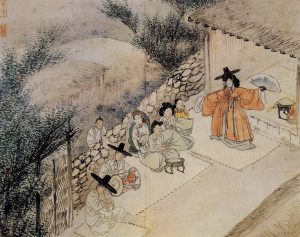
Figure 1. Shamanic Dance (Munyeo Sinmu) by Shin Yun-bok, ca. after 1805. Kansong Art Museum, Seoul. Source: Wikimedia Commons.
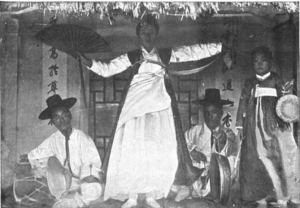
Figure 2. A Pretty Sorceress, 1904. From En Corée by Angus Hamilton. Source: Wikimedia Commons
The main source I used in this study is the Compendium of Korean Oral Literature (한국 구비문학 대계), provided by the Academy of Korean Studies, where I was able to locate most of the mugas. When I first read them, I realized that many of these songs contained Korean regional dialects. This was one of the challenges I faced.
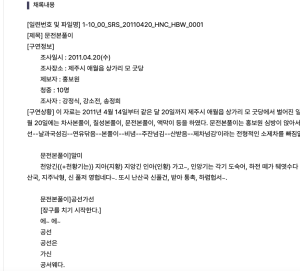
Figure 3. Content from the Compendium of Korean Oral Literature, (한국 구비문학 대계)
Most of the mugas were recorded in the late 1980s and 1990s by researchers who wanted to document people who knew the lyrics of particular mugas. In order to understand the dialects better, I decided to use AI, Gemini, to translate the dialectal text into modern official Korean.
By analyzing the muga texts, I wanted to find out what they revealed about gender representation and the social conditions of the time. Unfortunately, many of the sentences were missing subjects, so I could not tell which verbs belonged to which characters immediately. Because of this, I assigned each verb to a female or male character by examining the surrounding sentences and figuring out who was doing each action. After doing this, I had separate lists of sentences for female and male characters for each muga.
To examine gender representation, I extracted verbs from the texts using Python. I then looked at whether certain verbs were associated with female or male characters. My hypothesis was that verbs expressing more action or initiative might be more closely associated with male characters, while verbs such as giving, clothing, and sacrificing might be more closely associated with female characters.
After I had a list of verbs extracted by Python, I analyzed them using the digital humanities tool Voyant to see which verbs appeared most frequently. Voyant Tools helped visualize the frequency of these verbs and see whether there were any patterns. It was the first time I had a chance to see how digital humanities tools work.
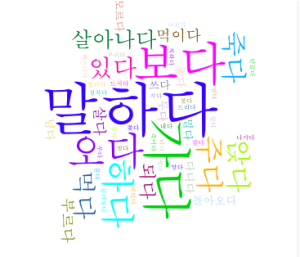
Figure 4. Verb Frequency Word Cloud Generated with Voyant Tool
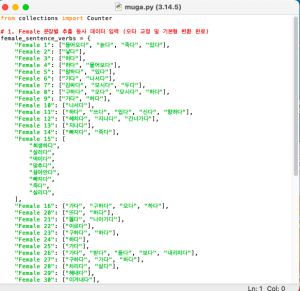
Figure 5. Python Script
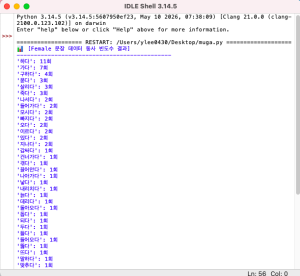
Figure 6. Python Generated Verb Frequency Results
After creating metadata using different metadata schemes to describe the mugas, my final goal is to create the project webpage using programming. I am excited, but also a little nervous, about this final stage of the project.
Through this practicum, I had the opportunity to explore different methodologies and realized that many of the knowledge and skills I learned in different courses can be easily connected. It was rewarding to bring together research on one aspect of my cultural background, metadata, digital humanities, and programming in a single project and to see how each area could influence the others. In the meantime, I was able to identify the areas that I found particularly intriguing and would like to develop further.
I am especially thankful to Kayo for giving me the opportunity to explore this project, allowing me to develop my own ideas, guiding me throughout the process, and staying genuinely engaged in my work.
The deliverable of the project is this website. It includes methodology and metadata records of the 5 Mugas analyzed, using Dublin Core, MODs, and VRA metadata standards.