Margery Somers Foster Center

At the intersection of digital technology, socially transformative media, and women and gender studies | Rutgers University Libraries

  • Transcribing Oral Interviews from the Douglass Alumnae Oral History Project

    It might be funny that I am making my first post about creating written documents when I’ve stated that I am working on a oral project. Yes, this is the Douglas Alumnae Oral History Project and yes, the primary documents that are to be highlighted in my work will be the multimedia interviews themselves; however, transcription, or the act of transferring audio information into its written form, is required.

    Back in the day, before digital technology induced a new ease into the sharing and access of multimedia resources, transcription definitely was required. No question about it. It was the best and cheapest way oral interviews could be disseminated to the public. Unless able to attend the physical creation of the interview or to access the item or recording that this interview became, one settled for the word-for-word rendering printed on pages in books, newspapers, or magazines. An oral interview, if to be publicized, was to be paired with its transcription.

    Still today, the act of transcription often accompanies the creation of an oral interview despite our abilities to easily replicate audio files and embed audio and video into webpages. Perhaps it is an indicator of this present society’s continued emphasis on the written word over the spoken; but that can only be part of it. Transcription ultimately promotes greater access, the goal to which librarians and information professionals must fix their actions.

    Reasons to create transcriptions for oral interviews:

    • Clarification of speech that is unclear or disrupted in the interview
    • Allows audience to skim content quickly for relevance or interest
    • Full text search capabilities
    • Most stable option for archival preservation
    • Improved access for those with hearing or other disabilities

    All of these reasons boil down to access. By providing transcriptions to an audio resource, by providing two expressions of a single work, we are simultaneously providing greater opportunity for users to explore and interact with these materials.

    So then, why is there the question as to whether to transcribe or not at all? Need I say it? Need I mention yet again those two constraints against which, not only libraries, but all efforts of our society must scrape and claw and crawl against…

    I will: time and money.

    Time = money and money = time. Transcription can take a long time. Though many of the interviews in this collection have already been transcribed, I took it upon myself to try it out since I figured it would help give me a real sense of the essence and matter of the project I am supporting. And I really did. I feel intimately attached to the interview I listened to and rewound and rewound and rewound and rewound until I created a decent script of it. But this intimacy took time to establish, about seven hours for this forty five minute interview. Maybe this  could be attributed to the fact that this was my first time transcribing an interview and that I worked without the assistance of any specialized transcribing software or equipment. But it took a while as transcription generally does.

    I’m an unpaid intern, so what I do with my time is appreciated but it doesn’t necessarily affect the bottom line, unless I mess up terribly or become a huge success and somehow win the Douglass Library tons of money. I am expected to produce what I said I will, but no money (except my own really since I am paying for the credits I am earning) is spent on my toils. You, however, may not be in my position. You (and I can even be talking to my future self here) are a paid employee who is a financial investment of your company or institution in return for being a recognized producer of thought, content, and services. How can you spend all of your time on one item when there are hundreds, maybe thousands, under your responsibility, a responsibility whose fruition costs money? Is this effort worth it?

    Well, the answer to that one depends on the context. In my instance, where I am creating a website in order to act as an educational resource for students or other interested parties, the act of transcription is worth it. Educational resources should be made as easily accessible as possible for all kinds of users and all kinds of needs since, I’m sure we all agree, education is for everybody. While there are issues regarding the usefulness of orthodox transcription methods for users like the Deaf community, it is still important that we try the best within our means to provide as much assistance as possible to these groups. Often when transcribing, the transcriber must confront the conflict between capturing the meaning of the speaker’s words and recording them verbatim. What information is lost if this verbal stalling is left out? How much editorial work for clarification’s sake is acceptable before the transcription strays too far from the original source?

    These are difficult questions to answer uniformly though it could be met with the tried and true “know your user community”. I know most of my users are likely going to be using these materials for college level class projects (at least that is this project’s intention and this purpose may change once it is released into the world) and it is for this user group that my creations must serve. How can I facilitate students looking for which interview to pick for a project? How can I incite interest, draw connections, or aid critical thinking? In what ways can I aid those with different needs? Questions, questions, questions. To be a librarian is to have a thoughtful position.

    I had mentioned earlier software or equipment that might aide those who feel the need for the sake of their users, like me, to include transcribed text along with their audio materials. Free software is available like Express Scribe that slow down the speed of the recording and allow for keyboard shortcuts for certain words. I learned that foot pedals exist that rewind the recording with the touch of a foot, keeping the hands free and also keeping the transcriber within one program, unlike me who was constantly switching back and forth between iTunes and Word.

    There are also plenty of resources online that offer assistance and tips for best practices for those transcribing audio into text.

    • This article Transcribing Oral History in the Digital Age by Linda Shopes on the Institute of Museum and Library Services website expands the conversation I’ve started here about the choice of creating transcriptions for and oral collection and provides extremely helpful questions pertaining to the planning, value, and issues that should guide this decision.
    • Transcriptions on the Web by Shawn Lawton Henry offers some great advice for creating a effective and useful transcripts that will work to further promote your audio collection.
    • This information sheet from East Midlands Oral History Archive lists useful style guidelines for the transcription documents themselves and also explains the importance of summaries in addition to audio materials and accompanying transcribed text. <\li>
    • Questioning why machines can’t just do this for us already? Check out this article about Automatic Speech Recognition (ASR) technologies and its current capabilities within the oral history community.

    In short, there are many ways to transcribe documents better than I did, just winging it, for my first time. To transcribe should succeed thought and reflection as to first, what value this transcription will provide your collection for its users and second, the means by which they will be created. Determine how users should be able to access these materials and continue to work with this access in mind. Of course transcription can never capture all of the information held within the oral interview, the ultimate primary document in this case, that only sounds can so effortlessly communicate: the informative power of emotion, a stutter, a speech pattern. The content, though, of the interview, its themes, its purpose, its meat can be better accessed and discovered in different ways through its written expression, even in this digital age.

    I have another interview to finish transcribing, but then I will be moving on to choosing exactly who will be able to appear on my website. I have a lot of standardization, checking of permissions, and curation ahead of me, so I’m sure I’ll have something interesting to say on those in the future. Thanks for reading and please read on!


  • Fall 2015 Intern for the Douglass Alumnae Oral History Project

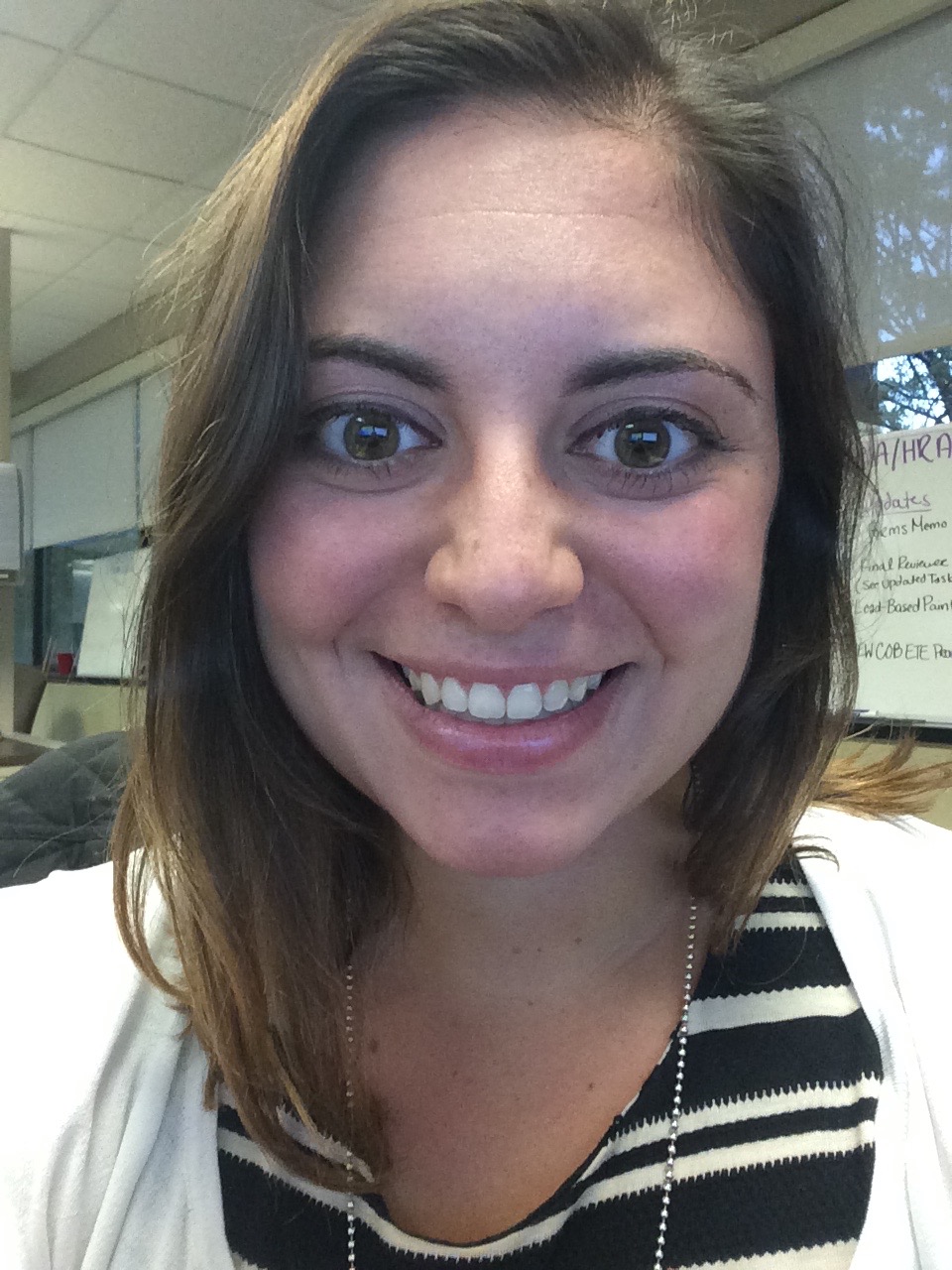
    My name is Karen Loder and I am pleased to introduce myself as one of two new interns beginning this fall semester at the Douglass Library!

    Karen Loder
    Not very good at smiling in pictures but at least I’m patriotic!

    As two graduate students working towards our Master of Library and Information Science degree here in the SC&I building on College Ave, my partner Ally and I are working under the supervision of Kayo Denda, who has already proven to be a wonderful help and motivator, to provide access to valuable Douglass College records that perhaps you didn’t know existed and that you’ll hopefully find useful and easily by the end of this semester. This is my last semester at Rutgers before I receive my MLIS and I am very glad that I found an internship that suits my personal interests and encourages the development of my professional experiences!

    My main project for this semester is to create an accessible and appealing web portal for the Douglass Alumnae Oral History Project, an audio project comprised of rich exchanges between past graduates of the New Jersey College for Women and Douglass Alumnae. Memories of college life, social and academic, and the inextricable larger political landscape of Rutgers, New Jersey, and the United States are shared by participating alumnae for the strengthening of Douglass College’s history through the students that lived through, shaped, and prospered from it. One of the most fascinating characteristics of this project to me is the perspective of the college that these interviews illuminate. Often we are able to trace the policies and attitudes of deans and professors who acted as figureheads of the institution, but little are we aware of how these actions influenced those who were the subjects of them. While I am personally interested in seeing what I could learn from these women, as an aspiring librarian, I am essentially devoted to seeing what the public can learn from these recorded interviews.

    Maybe this perspective interests me so much because it is the one from which I have primarily experienced the world. I graduated from Fordham University with a degree in English and a minor in Creative Writing in 2014 so I love to read and write, though I’ve been finding myself a much more avid reader than writer recently. Much of my life has been spent in a book like how much of my life has been spent as student which, though I’m trying to change that now, is not something I would change about myself since I think I’ve collected quite a bit of material with which I act with tact and fact. To intake people’s thoughts–what they consider important, right, or reality–through their verbal instruction or from a written (or digital) record may never provide the most objective account, but will always reveal some piece of the truth that can illuminate the whole. I may truly have found the best project for me as a supporter for this oral history project since I am a great listener!

    Throughout this semester I am going to keep you updating on my progress and the process of creating a web portal that should ultimately provide you with not only access to these oral histories but also with a site that contextualizes this project within the larger history of Douglass College and thus pronounces its importance. I will also try to provide some information regarding how to do what I’m doing in case you have a valuable oral history collection yourself that you want to make accessible and visible on the web. Stay tuned!


  • Margery Somers Foster Center- Fall 2015 Internship

    My name is Alexandra Steiger and I will be participating in an internship at the Margery Somers Foster Center this fall! I am currently working on my Masters Degree in Library and Information Science from the School of Communication and Information at Rutgers University.  I also received my Bachelor’s Degree in English from Rutgers.

    Allie Steiger

    My interest was certainly peaked when I heard about the project that was being conducted here at the Margery Somers Foster Center.

    They have been conducting a project that will capture, restore, and preserve oral histories from women who graduated from the New Jersey College for Women.

    scrapbook page

    The New Jersey College for Women became known as Douglass College in 1955 after Mabel Smith Douglass, the college’s founder.

    In keeping with Rutgers’ mission of diversity, these women who were interviewed are from many different backgrounds and each have a unique perspective on life at the New Jersey College for Women.

    I will be specifically looking into scrapbooks from students and graduates in order to provide visual representations of life at Rutgers. The team has found that Dean’s papers as well as yearbooks do not go far enough in creating a rich understanding of what life was like at the New Jersey College for Women.

    Personally, I have made many scrapbooks of my family and friends in the past. Scrapbooking has become more commercial in recent years as stores like Michael’s and A.C. Moore have entire sections devoted to tools for scrapbooking. I understand the care it takes to insert and position memorabilia into a book that will hopefully be preserved for many years. Creating scrapbooks, as well as viewing them, produces a very strong emotional and nostalgic reaction for me. Throughout this internship, I would like to the see how the history of scrapbooking has shaped its current popularity.

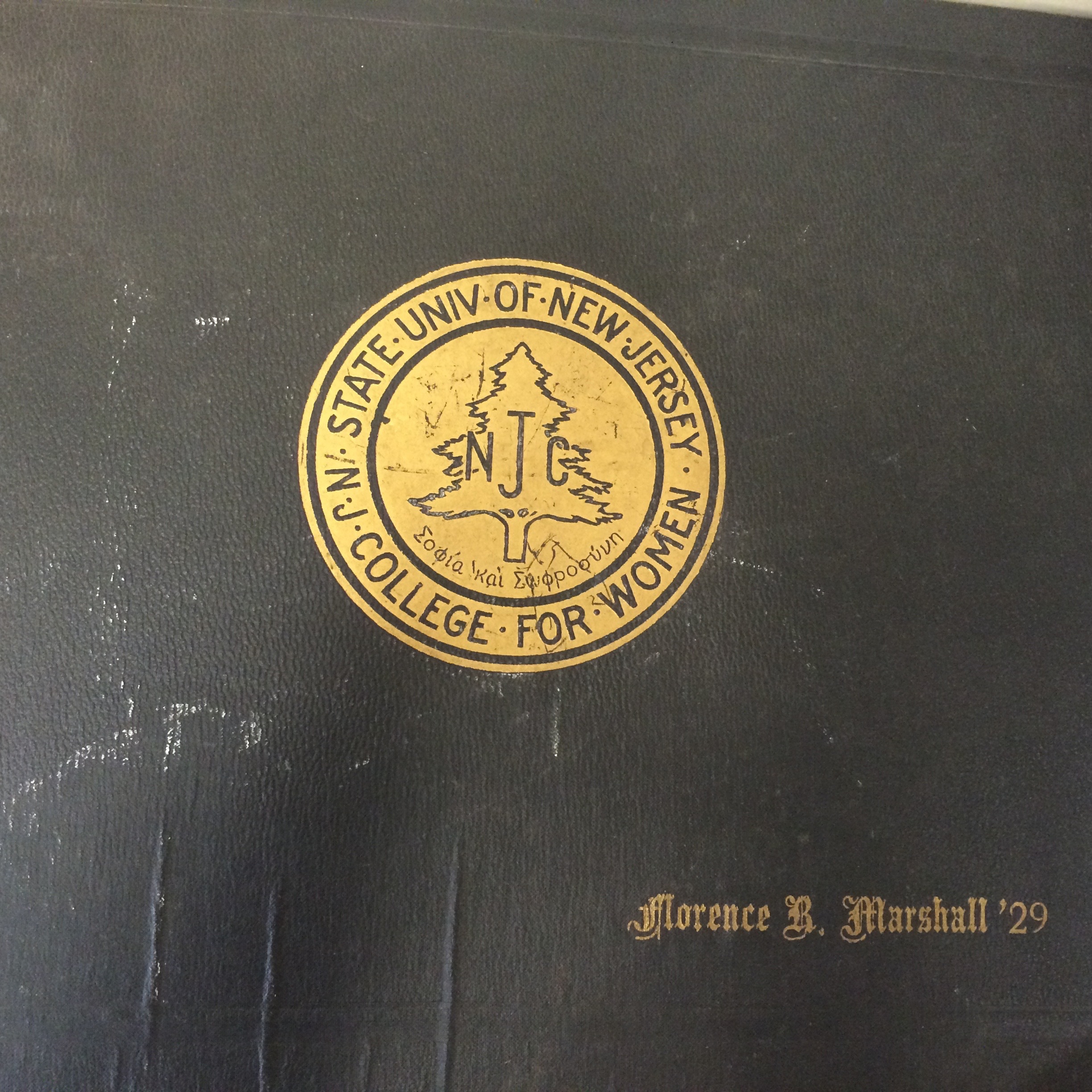
    Kayo Denda, head of the Margery Somers Foster Center, has already obtained one scrapbook from a woman named Florence Marshall who later became Florence Nash. Florence graduated from the New Jersey College for Women in 1929.

    Florence Marshall Scrapbook Cover
    New Jersey College for Women class of 1929 graduate, Florence Marhsall’s Scrapbook Cover

    I will strive to find other depictions of life in that time period. I will be unearthing scrapbooks throughout my internship and I will share my findings as I move through the semester.


  • Congratulations to Aresty Students Aya Sakar and Kelly Jin

    At the Aresty Undergraduate Research Symposium on Friday April 24, 2015 Aya Sakar ’15 and Kelly Jin ’17 presented 2 projects they have worked since September 2014. Both projects explore different aspects of the history of Douglass College.

    Aya’ project Perspectives on Diversity and Multiculturalism on Douglass Campus, from the 1920s to the 1950s identifies women of color from Quair yearbooks and track their post-Douglass years with the archival material from the Associate Alumnae of Douglass College and other sources. The majority of women became teachers and librarians. Although most women were from from New Jersey, there were international students from Japan, Egypt, India, China, and Iran. This project received one of the three honorable mention awards in the Humanities Category.
    Aya Saka and poster erspectives on Diversity and Multiculturalism on Douglass Campus, from the 1920s to the 1950s

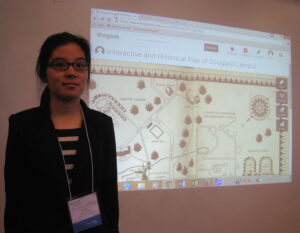
    Kelly’s project Mapping Douglass Campus, 1920s to 1950s, consists of an interactive historical map (ThingLink)  embedded with images of buildings and quotes about the buildings by the founding Dean Mabel Smith Douglass, passages from Alumnae Bulletin, and quotes from Douglass alumnae from the Douglass Alumnae Oral History Project interviews.  Kelly hopes this interactive map can introduce incoming Douglass Residential College students more accessible information on college history.

    Kelly Jin  and project Mapping Douglass Campus, 1920s to 1950s,


  • 5th Annual Undergraduate Multimedia Award Winners

    This is a guest post by Peregrine MacDonald, a Rutgers MLIS student and information assistant at Douglass Library.

    We are pleased to announce the winners of the 2015 Margery Somers Foster Undergraduate Multimedia Award. We invite all members of the Rutgers Community to attend the fifth Annual Celebrating Creativity event, where the awards will be presented. The event will be held on Thursday April 16, 3-5PM, in the Mabel Smith Douglass Library on the Douglass campus.

    The undergraduate multimedia award acknowledges the creative use of university library collections in the production of a multimedia-based research project focused on women’s or gender issues. The Libraries are pleased to recognize five projects, including two award winners, an honorable mention, and two finalists. The two award recipients are:


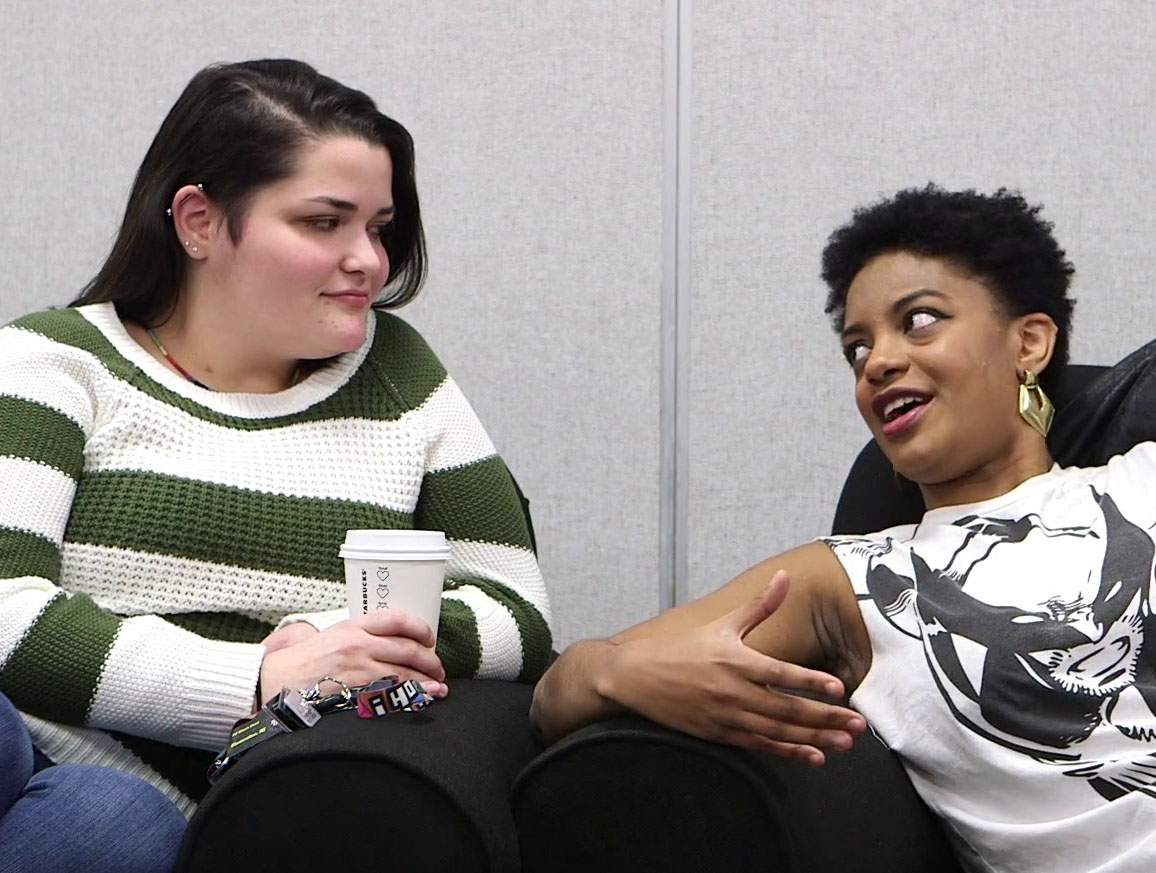
    still from Becoming Syd
    Becoming Syd

    Lauren Caputo, a senior majoring in communications, won the award for her project “Becoming Syd” a short documentary about a transgender-queer relationship that explores how these relationships can help shape identities. It was created in the course Directing the Documentary (spring 2014) taught by Ross Kauffman, an Academy Award winning documentary filmmaker.


    still from It Gets Better
    It Gets Better

    Several students taking the Rutgers-Camden courses Gender and Sexuality in Literature, taught by Ellen Malenas Ledoux, and New Queer Cinema, taught by Dawn Walsh, won the award for their project “It Gets Better.” The project was conceived as a grass-roots version of the Internet-based social activism with the same name. It offers specific suggestions for how LGBTQ+ rights can be furthered on both interpersonal and policy levels.


    poster The Role of Local Action: Birthing Kits and Maternal Mortality
    The Role of Local Action: Birthing Kits and Maternal Mortality

    Michelle Muska, a senior majoring in Environmental Policy, Institutions & Behavior, and Antoinette Gingerelli, a sophomore majoring in Political Science & Women’s Studies, will be recognized with an Honorable Mention for their project “The Role of Local Action: Birthing Kits and Maternal Mortality.” The project proposes local action to reduce maternal mortality and unsafe birth in conflict and crisis areas. This was a social action project for 2015 Douglass Global Summit and the Douglass Friends of United Nations Population Fund (UNFPA) advised by Margot Baruch.

    We would also like to recognize the two other finalists. Dara Harvey, majoring in public health, submitted the project “The Role of Women in Fairytale: Happily Ever After?” created for the Creating Writing course. Amy Ho, majoring in cell biology and neuroscience, submitted the project “Police Brutality Against People of Color,” created for the Introduction to Multimedia Composition course. Chris Rzigalinski is teaching both courses this semester (spring 2015).

    This year’s awards were made possible in part through the support of Dr. Irene Gnarra.

    More photos. from the event are available.


  • New Students at the Margery Somers Foster Center

    This semester at the Margery Somers Foster Center there will be four Rutgers University students working on their respective research projects. With their combined effort, the MSFC is sure to be teeming with hard work and dedication. The four students and their projects, some coinciding with each other, are listed below.

    Lauren Carboy is in her final semester of the Master of Library and Information Science Program at Rutgers online.

    Lauren Carboy

    She is currently involved in a for-credit internship focusing in digital libraries. Her main project involves the Douglass Alumnae Oral History Project, which collects the stories of various Douglass Women’s College/NJC graduates throughout the years by way of interview. While additionally working on project organization, digitization, and transcription itself, Lauren plans on creating a short video documentary on one specific new interviewee, Susan Schwirk, and the unique story she has to tell. She hopes that working on the project and the video will display her digital, multimedia, and organizational skills positively, as well as giving her welcomed experience in digital humanities.

    —–
    Alex DelPriore
    Alex DelPriore is in his second semester of the on-campus MLIS program at Rutgers, with a planned specialization in Digital Libraries. He is currently exploring options for a virtual map and tour of the Mabel Smith Douglass Library, utilizing multimedia including 360° panorama views and video, to enable online users to familiarize themselves with the facilities, services, and spaces the library has to offer. Alex is also working on new potential formats and programs for a second mapping project of Douglass Campus which is fully explained in the next paragraph below.

    —–

    Along with Lauren and Alex, there are two Aresty students working within the Margery Somers Foster Center. Kelly Y. Jin is a Douglass Residential College student who plans to graduate in 2017.

    Kelly Jin

    She is majoring in computer science, and her project is entitled “Mapping Douglass Campus with Douglass Women’s Narratives: 1930’s through 1960’s.” In collaboration with the Douglass Alumnae Oral History Project, the assignment will take information from the interviews about buildings, landmarks, and physical spaces that were valued by the students on campus, and map them on an interactive map of Douglass Campus. The project will surely create an experiential narrative of college spaces over the course of four decades. It will also examine the women’s liberation movement in the 1960’s and the changes that amassed from it.

    —–

    The second Aresty student is Aya Sakar, a senior double majoring in English and History with a minor in Women’s and Gender Studies.

    Aya Sakar

    Aya is working on yet another project, entitled “Perspectives on Diversity and Multiculturalism on Douglass Campus from the 1930’s to the 1980’s.”This project hopes to illustrate how Douglass became a diverse and multicultural community, putting its focus on Rutgers black student protests, civil rights activism in the 1960’s, and showing how diversity affected campus culture with its influence on policies, student life, and the enrollment and hiring processes. The project will demonstrate Aya’s researching skills, as well as her digital and multimedia knowledge production skills.


  • 3D Printing, Digital Humanities &

    Guest post by Angela Pagliaro, Information Assistant, Mabel Smith Douglass Library

    The new MakerBot 3D printer is up and running in the Fordham Commons on the lower floor of the Mabel Smith Douglass Library. Learn more about the Makerspace on our LibGuide. 

    Having 3D printers at Rutgers is a game changer for the humanities. Students now have a tool that allows them to engage and replicate content from the classroom. Having this type of technology creates endless possibilities of how students can interact with content. These types of interactions are essential for creativity and learning in the humanities, for more information about art and archaeology and 3D printing, check out Making Digital: Visual Approaches to the Digital Humanities from the Journal of Digital Humanities.

    makerbot replciator: 2

    With these printers now at Rutgers, students and faculty have an opportunity to learn actively and create tangible items that can help others learn. The space is not one of designated silence but instead one where any subject can take physical form.

    makerbot internals priting something

    If history classes that study the layout of ancient Rome or Nebuchadnezzar’s garden, they can be replicated and brought to life with the 3D printer. Students can spend more time thinking about the details of the content and truly engaging with what they’re learning instead of obtaining the information passively. Technology has relevance to any area of study, especially the humanities, since maker culture is about designing, building, and repurposing.

    For more information about the makerbot, contact Stacey Carton (sacarton@rci.rutgers.edu)


  • Join Us to Celebrate Creativity

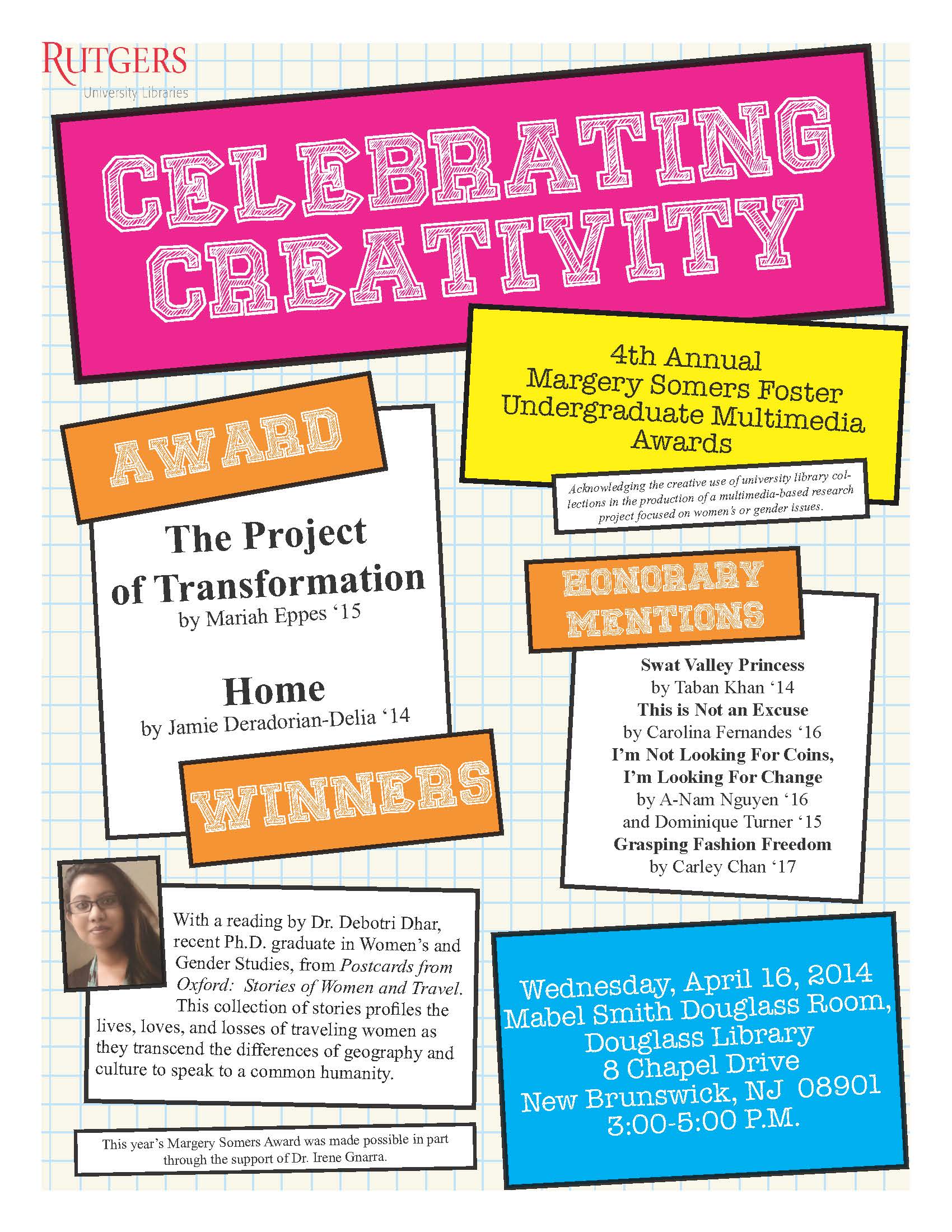
    Please join us tomorrow, Wednesday, April 16 at 3 p.m. at the Mabel Smith Douglass Library to honor the winners of the Undergraduate Multimedia Awards and for a reading by Dr. Debotri Dhar, a recent Ph.D. graduate from Rutgers Women & Gender Studies department, from her book Postcards from Oxford: Stories of Women and TravelCelebrating Creativity Flyer


  • 4th Annual Undergraduate Multimedia Award Winners

    We are delighted to announce the winners of the 4th Annual Undergraduate Multimedia Awards. We hope that you will be able to join us in presenting the awards at the event, Celebrating Creativity, Wednesday, April 16 in the Douglass Room at the Mabel Smith Douglass Library.

    Co-Winners of the Margery Somers Foster Center Undergraduate Multimedia Award

    The Project of Transformation by Mariah Eppes ’15

    Mariah created this short documentary this semester for the Institute of Women’s Leadership with supervision from Sasha Taner. The video documents the work of Cheryl Clarke, a former Dean of Students at Rutgers University and poet, discusses her upbringing in Washington, D.C. during the Civil Rights Movement, her passion for writing, and the role of feminism. Clarke is a black lesbian feminist whose poetry, editorial work, and career at Rutgers has had a significant impact on black, lesbian, and women’s communities. This video is currently only available as a DVD. Please contact Kayo Denda at kdenda@rutgers.edu if you wish to arrange to view the film.

    Project of Transformation

    Home by Jamie Deradorian-Delia’14

    Jamie created this video in the Fall 2013 semester for the Web series/filmmaking class at the Center for Digital Filmmaking under the supervision of Patrick Stettner. This short documentary/video art hybrid piece discusses the pressures that one woman feels to conform to the societal standards of beauty. It uses one character as a conduit to explore the issue of arbitrary definitions and labels that are put on her. View Home on Vimeo.

    Still from Home by Jamie Deradorian


    Honorable Mentions

    Swat Valley Princess by Taban Khan’14

    This short documentary focuses on Zebu Jilani, who is giving back to her community in Swat Valley, Pakistan. Swat, originally considered the “Switzerland of Pakistan” has been controlled by Taliban militants in 2007 and suffered massive destruction by the earthquake in 2009. Zebu and her husband have found a non-profit organization to improve water quality, health care and reduce poverty of its women and children. View Swat Valley Princess on YouTube.

    I’m not looking for coins, I’m looking for change by A-Nam Nguyen ’16 and Dominique Turner ’15

    This short documentary film project is a profile of Jill Tice, a woman who is homeless and living in the city of New Brunswick. Jill talks about her childhood in Edison and her subsequent descent into poverty and homelessness due to drugs. She describes her experiences living on the street and her efforts at educating those in the community about what it is like to be homeless and how they can help in small ways. View I’m not looking for coins, I’m looking for change on YouTube.

    This Is Not an Excuse by Carolina Fernandes ’16

    This online book project attempts to bring awareness to SlutWalk, a movement that protests the tendency to refer to women’s clothing as a cause for unwanted sexual attention. She photographed college women in “party clothes,”asking the students to wear an outfit they would normally wear to a party. Putting this body of work in book form, stories of women who were raped or almost raped in college, specifically Rutgers, were added. View This Is Not an Excuse.

    Grasping Fashion Freedom by Carley Chan ’17

    In this blog, Carley explores the notion of American freedom through her passion for fashion and consumerism to fulfill this passion. She comes to see through the research project that she has become a victim of societal expectations and norms placed on women. She hopes her blog serves as an intervention for young women to think more critically about their fashion and consumer choices. View Grasping Fashion Freedom.